

Priority Industrial Sectors in Egypt A Comprehensive, Data-Driven Guide to 15 Strategic Sectors

When industrial policy references 'priority sectors,' attention typically focuses on the final product. The car rolling off the assembly line, or the package of medicine arriving at the pharmacy. Yet behind every finished product stands a complex ecosystem of "feeder industries" such as components, raw materials, and intermediate inputs—that ultimately determine whether Egyptian industry can transition from assembly and packaging to actual manufacturing and true localization of domestic industry. Hence these inputs are not defined by commercial brand names but rather by officially accredited tariff classifications, accurately tracking and monitoring them requires relying on this classification as a unified language that enables the precise identification of each material or component, linking it directly to the industry or production line that requires it. Any investor or factory owner can verify the classification of their activity or product through the directory of codes and products provided by the Industrial Development Authority (IDA)
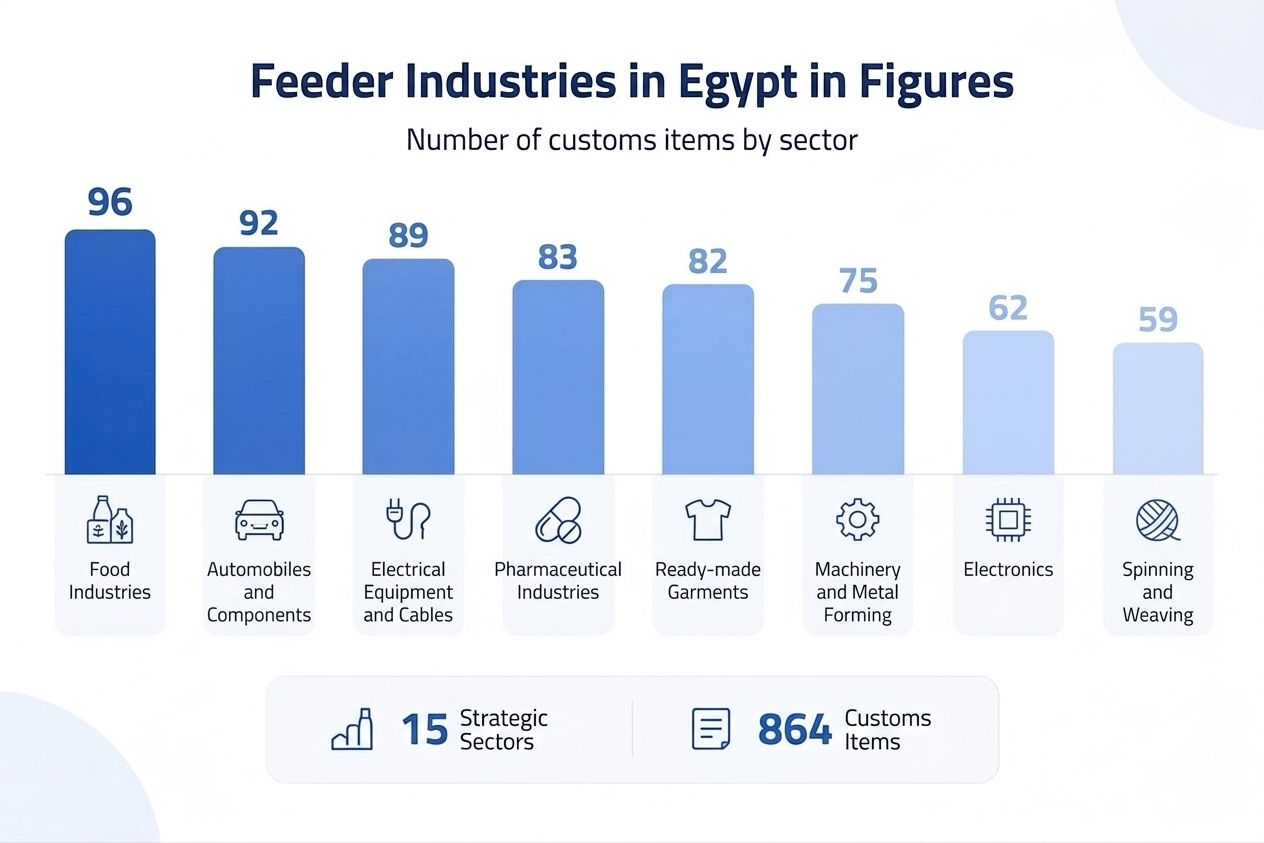
In this article, we present an analytical reading of a comprehensive map encompassing 864 tariff items, distributed across 15 strategic industrial sectors. It reveals a striking pattern: many feeder industries do not serve a single sector alone, but extend to supply several priority sectors at the same time.
What Are Feeder Industries and Why Do They Receive Priority?
Feeder industries are those that do not produce a final good purchased directly by the consumer; instead, they produce the components, raw materials, and intermediate inputs that other, larger industries rely on to build their final product—such as the non-woven textile raw materials industry that serves textiles, or the active ingredients and glass ampoules industry that feeds the pharmaceutical sector. These industries gain special priority in Egyptian industrial policy for the following reasons:
- Achieving integration between input-producing factories and the sectors that use them across various manufacturing stages. Instead of importing all components of the finished product, providing these inputs locally helps build more integrated supply chains, which represents the core of the local industry localization process.
- Reducing the delivery time of raw materials, improving the ability to monitor quality, and responding to factory needs, which aligns with the state's direction toward deepening domestic manufacturing and localizing industrial supply chains.The Industrial Development Authority (IDA) confirms that directing investment opportunities toward specific feeder industries aims to secure supply chains, bridge import gaps, and maximize exports through an integrated system of incentives and investment opportunitiestargeted at these industries.
Key Priority Industrial Activities
Feeder industries in Egypt are distributed across a group of priority sectors that represent main pillars in the domestic manufacturing framework. Data from the list under analysis reveals that this system extends to a number of major sectors and industrial activities: ready-made garments, spinning and weaving, food industries, pharmaceutical industries, automotive and components, electrical equipment, cables and appliances, electronics, machinery and metal forming, solar and renewable energy equipment, iron, steel and aluminum, chemicals and fertilizers, building materials and marble, critical minerals, plastics and rubber, paper, packaging and printing.
The following analysis offers in detail some of these strategic sectors, while the full list of sectors and detailed tariff items can be accessed through the file attached at the end of the article.
This diversity reflects the broad scope of feeder industries, which are not limited to a single sector, but rather include components and inputs that serve multiple industries and support the integration of production chains. Investors can verify whether their targeted activity falls under these priority sectors by querying the industrial activity or product directly through the IDA website.
-
Pharmaceutical Industries... From Active Ingredients to Packaging
The pharmaceutical industries sector ranks fourth among the highest-density sectors in terms of tariff items, with 83 tariff items, reflecting the very nature of the pharmaceutical industry: a long and complex supply chain. Feeder industries range from active pharmaceutical ingredients (such as antibiotics, cardiovascular and oncology drugs, steroid hormones, penicillin and its derivatives), passing through packaging inputs such as injection glass and Type I (borosilicate) ampoules, aluminum foil for tablet packaging, to empty gelatin capsules and sterile medical syringes. This diversity explains why localizing the pharmaceutical industry remains a complex challenge that cannot be solved by a single factory, but rather through an entire ecosystem of inputs..
-
Machinery and Metal Forming... The Tool That Builds Industry
بWith 75 tariff items, the machinery and metal forming industry represents a special case, as it does not feed a specific end product as much as it feeds the "capability to manufacture" itself—starting from Computer Numerical Control (CNC) cutting machines, molds, and dies, to filtration equipment, industrial water treatment, and packaging machinery. Investment in these feeder industries has a multiplier effect, as any improvement in the local capacity to produce a machine or a mechanical component directly reflects on the cost and quality of dozens of finished products across multiple other sectors.
-
Electronics... The Brain and Digital Backbone of Industry
With 62 tariff items, the electronics industry reflects an effort to transition from "assembling devices" to "manufacturing components" through pivotal inputs such as semiconductors, integrated circuits, printed circuit boards (PCBs), photovoltaic cells, and display screens of various technologies. This sector strongly intersects with both electrical equipment and automotive sectors, as will be shown later.
-
Food Industries... The Most Diverse in Feeder Industries
The food industries sector tops the list with 96 tariff items, outperforming other vital sectors, and features a wide diversity in its feeder areas across 22 sub-industries. These inputs range from yeasts and fruit juice concentrates, through whey, to infant food bases and plant thickeners like pectin. This diversity reflects the nature of food industries as a sector serving a broad base of daily consumption, relying on a vital ecosystem of supply, packaging, and refrigeration chains.
-
Automotive and Components... The Engine of Transition to the Future
The automotive and components industry ranks second among the highest-density sectors with 92 tariff items. A notable aspect in this sector's data is the clear presence of electric vehicle inputs alongside traditional components—ranging from lithium-ion battery packs and cells designated for electric vehicles to electronic control units, sensors, braking systems, transmissions, and radiators. This combination indicates that the feeder industries map does not merely document the reality of the current industry, but clearly anticipates the global and local transformation trend in the automotive sector.
-
Electrical Equipment, Cables, and Appliances... The Hidden Engine of All Sectors
This industry ranks third with 89 tariff items, representing one of the most comprehensive areas capable of serving a wide range of other industrial sectors. This is due to the direct reliance of modern facilities and factories on electric motors, cables and conductors, power and distribution transformers, and control and circuit protection systems. The importance of these feeder industries lies in their ability to support other sectors indirectly, making their localization a pivotal part of building a more integrated industrial system less dependent on imported inputs.
-
Spinning and Weaving... The Lifeline of Local Production and Textiles
With 59 tariff items, the spinning and weaving sector aims to provide a wide range of raw materials and intermediate inputs, including cotton yarn and blends, polyester fibers and yarns, acrylic fibers, as well as industrial woven and knitted fabrics. This sector is characterized by its direct organic connection to the ready-made garments industry, alongside feeding several other sectors and fields such as home furnishings and textiles, medical textiles, as well as technical and engineering products.
-
Ready-Made Garments... The Export Front and Added Value
The ready-made garments sector ranks fifth among the densest sectors with 82 tariff items, representing one of the highest priority industrial sectors in the national strategy for industrial development. This sector benefits directly from having an integrated local base of feeder industries providing supplies and intermediate materials (such as accessories, linings, and specialized sewing threads), contributing to enhancing the competitiveness of Egyptian products in local and export markets while reducing reliance on imported inputs.
What Are the Shared Feeder Industries Across Multiple Sectors?
Data on feeder industries in Egypt reveals an important characteristic: certain industrial components and inputs are not tied to a single productive sector, but rather emerge as shared needs across multiple industries. This reflects the interconnected nature of industrial supply chains and opens opportunities for investments that can serve multiple markets simultaneously.
This interconnection is clearly evident in reactive and disperse dyes,which connect both the ready-made garments and spinning and weaving sectors. These products are used in textile coloring processes; thus, developing their local production can support multiple stages, from raw textile materials to ready-made garment manufacturing.
In the equipment and machinery industry, electric motors intersect with both industrial machinery and equipment as well as electrical equipment.
Lithium-ion batteriesintersect directly across 4 strategic industries: automotive, electronics assembly, electrical equipment, and renewable energy equipment.
This pattern of dynamic overlapping holds significant meaning for industrial decision-makers: investing in a single feeder industry can generate a multiplier effect across more than one strategic sector. A factory producing lithium-ion batteries does not merely serve the electric vehicle industry; it extends to include electronics, electrical equipment, and renewable energy equipment. This raises the investment yield and positions these overlapping sectors as primary candidates for investment incentives. To convert these opportunities into active projects, IDA allows access to available lands and investment opportunities in these sectors via the Industrial Digital Platform of Egypt.

The Future of Feeder Industries in Egypt
Current indicators suggest that feeder industries will not remain merely a supporting tool for priority industrial sectors, but will gradually transform into a primary driver reshaping the map of Egyptian industry as a whole, due to several considerations:
●Expected Expansion in Emerging Sectors:With the accelerated global transition toward electric vehicles and renewable energy, the list of feeder industries linked to these sectors is likely to expand, becoming among the most attractive investment opportunities in coming years.
●Deepening Backward Linkages Between Sectors:The higher the number of intersection points among priority sectors, the more cohesive the Egyptian industrial system becomes, making it less vulnerable to external shocks in global supply chains.
●Continuous Updates to Priority Maps:As technology evolves and global demand patterns shift, feeder industry maps will require periodic review and monitoring to ensure investment remains consistently directed toward the most critical and prioritized inputs.
Ultimately, the future of Egyptian industry will not be measured solely by the number of factories producing finished products bearing the "Made in Egypt" label, but by the depth and solidity of the feeder industries backing those products.
This is the transformation the current map paves the way for. Out of a total of 864 tariff items covering 15 strategic sectors distributed across dozens of various feeder industries according to updated data as of the publication date of this article. A clearer picture emerges of what Egypt needs to deepen domestic manufacturing. This goes beyond attracting investments in end products, extending to target intermediate links within the supply chain in a precise and systematic manner, particularly those links where the interests of more than one strategic sector intersect.You can view and download the complete detailed data list(click here)